3.5. MESA 7I77 Board Configuration
3.5.1. 5 V Main Power
The MESA 7I77 board can draw its main 5V power either from the MESA 7I96S board or through its TB1 connector. This power is needed for the encoders, analog outputs, and the RS-422 interface. The main power mode for the MESA 7I77 is selected using jumper W5 as follows:
If
W5is in the left position, power is supplied via the MESA 7I96S board. In this case, jumperW6on the MESA 7I96S board must be set to the up position.If
W5is in the right position, power must be supplied to the board externally through theTB1connector. In this case, jumperW6on the MESA 7I96S board must be set to the down position to prevent it from supplying power to the daughterboard.
Attention
Supplying power to the MESA 7I77 board through the TB1 connector with jumper W5 in the left position can potentially damage the MESA 7I77 board, the MESA 7I96S board, the connection cable, and even the PC.
In our testbed setup, we chose to power the MESA 7I77 board via the TB1 connector; therefore:
Jumper
W6on the MESA 7I96S board has been set to the down position, as shown in Fig. 19.Jumper
W5on the MESA 7I77 board has been set to the right position, as shown in Fig. 20.
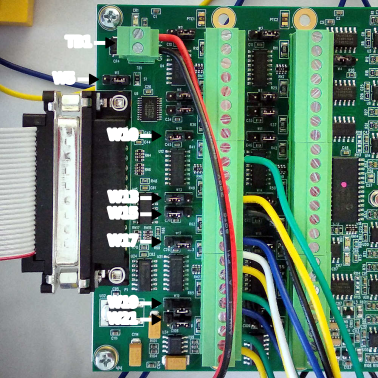
Fig. 20 View of the left side of the MESA 7I77 board.
3.5.2. Digital Inputs and Outputs Power
In addition to the 5V main power, the MESA 7I77 board also requires supplementary power for its digital inputs and outputs through the TB2 connector (see Figures 2 and 21). The pinout for the TB2 connector is provided in Table 4.
Pin |
Signal |
Function |
|---|---|---|
1 (bottom) |
|
|
2 |
|
|
3 |
|
|
4 |
|
|
5 |
|
|
6 |
Not connected |
– |
7 |
Not connected |
– |
8 (top) |
Ground |
Reference of |
As indicated in Table 4, the board requires two power inputs in this configuration:
VFIELD: This input supplies power to the outputs and determines the logic levels of the inputs, with a range of 5 V to 28 V.VIN: This input provides power to the input/output logic, with a range of 8 V to 32 V.
If VFIELD is between 8 V and 28 V, the same source can be used to power VIN. The board includes jumper W1, which, when placed in the left position, connects VIN with VFIELD. To use VFIELD values outside the VIN range (e.g., 5 V), you must place W1 in the right position to disconnect VIN and VFIELD, allowing for separate power supplies for VIN and VFIELD.
Attention
The voltage at VFIELD must have a maximum rise rate of 10 V/ms to prevent damage to the board. This is a limitation of MOSFET transistors [Cor18a, Cor18b, Nex23, BPH03]. Therefore, VFIELD must be connected directly to the power supply without using switches in the circuit.
As stated in Section 2.5, the MESA 7I96S board can only use 5 V logic for step and direction signals. Therefore, the logic for both the igus® dryve D1 controllers and the MESA 7I77 board must also be 5 V. Thus, in our testbed setup, jumper W1 on the MESA 7I77 board has been set to the right position, the VIN input to 24 V, and the VFIELD input to 5 V, as shown in Fig. 21.
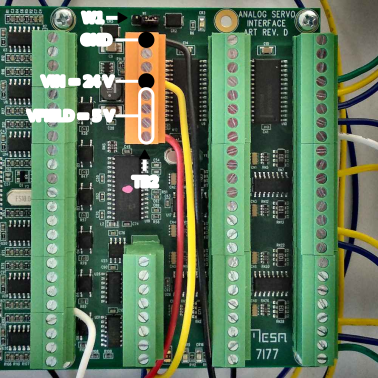
Fig. 21 View of the right side of the MESA 7I77 board.
3.5.3. Encoder Input Modes
The MESA 7I77 board has six encoder inputs, each with individual A, B, and Z inputs. These inputs can be configured to operate with either differential or single-ended signals. Each encoder has three jumpers to configure the mode for its individual A, B, and Z inputs. Setting a jumper to the right position selects differential mode, while setting it to the left position selects single-ended mode. The list of jumpers for the individual inputs of each encoder is provided in Table 5.
Encoder |
Jumper A |
Jumper B |
Jumper C |
|---|---|---|---|
0 |
W21 |
W19 |
W17 |
1 |
W15 |
W13 |
W10 |
2 |
W8 |
W6 |
W2 |
3 |
W22 |
W20 |
W18 |
4 |
W16 |
W14 |
W11 |
5 |
W9 |
W7 |
W3 |
In our testbed setup, the following MESA 7I77 board encoder inputs and modes were used:
The stepper motor encoder was connected to input 0. This encoder uses differential signals, so jumpers
W21,W19, andW17were left in their default right position.The brushless motor encoder was connected to input 1. This encoder uses single-ended signals, so jumpers
W15,W13, andW10were set to the left position.
The configuration of the aforementioned jumpers for encoders 0 and 1 on the MESA 7I77 board in the testbed setup is shown in Fig. 20.